EAA Winners, SCAF Artist Talk Series 2025 - Part 3
Jul 06, 2026Our Emerging Artist Award Finalists 2025
As we round off last year’s Emerging Artist Award artist talk series, this final conversation brought together three exceptional finalists whose practices explore time, memory, ritual, ecology and the human stories that shape our lives. Led by SCAF’s curator Lydia Poole and Amelia Pethullis, the session offered a rich and thoughtful close to the programme, weaving together three distinct voices that share a deep sensitivity to change, connection and the traces we leave behind.
Across the series, each talk opened a different doorway into the theme of time. This concluding discussion revealed how the finalists // Layla Jabbari, Lou Hazelwood and Ian Hinley // approach the subject through community, landscape, material transformation and symbolic imagery. Below, we share highlights from the conversation, alongside insights into each artist’s practice and their finalist works.
Lou Hazelwood
First Place Winner, Emerging Artist Award 2025
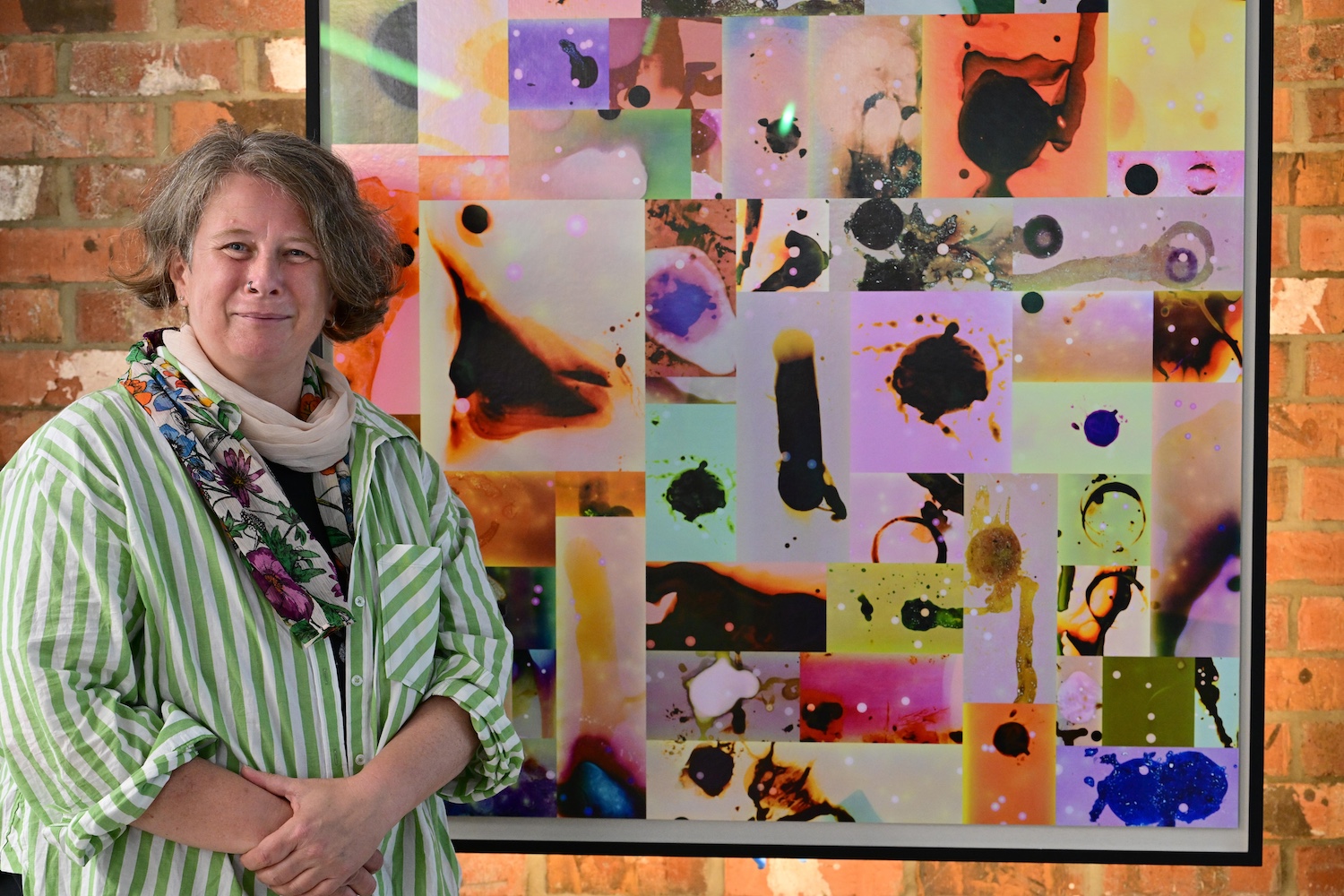
The Circle is Not
Photographic print 100cm x 100cm www.louhazelwood.com
Hull based artist Lou Hazelwood works across sound, text, film, installation, performance and image based practices. Her work investigates how personal and cultural experiences, and technologies both historical and contemporary, shape memory and forgetfulness. Over the last decade she has explored damaged film stock and photographic emulsion, manipulating their stability to understand what they record and what they lose.
Her winning work, The Circle is Not, is a time‑led photographic experiment that examines ecological change through the instability of film. The piece brings together Lou’s long‑running investigations into woodland chemistry and the shifting behaviour of photographic materials.
“Time brought two projects together, the chemistry of woodlands and Archetypes of Random. The film in this piece has differences and deterioration from how it’s been stored, and I’ve taken what I learned from sustainably gathering materials to alter photographic emulsion.”
Lou worked with expired 35mm colour film, already marked by natural redactions in the emulsion, and altered it further using chemicals foraged from East Yorkshire woodlands. Her process draws on conversations with countryside access officers and her own research into sustainable foraging.
“More acidic chemicals strip the film; more alkaline ones alter the colours. Even granular materials shift the emulsion.”
Her fascination with mycelium and ecological networks shapes the conceptual core of the work. She sees the woodland floor as a site of constant communication and transformation, a system that mirrors the instability of film itself.
“I’m fascinated with mycelium. Anything that dies in the woodland, this network goes in to degrade it. I’m thinking about communication not only between plants and trees, but also humans within the city.”
Lou prefers the word altered rather than decayed, emphasising transformation rather than loss. Her interest lies in the film’s ability to shift, respond and record change over time.
“I don’t quite like the word decay. Altered is better. I’ve shot film from the 1920s and 30s that hasn’t decayed beyond use. It’s the ability to shift the emulsion that interests me.”
The circle motif becomes a site of questioning. It gestures toward an aperture, a petri dish, a clock face, yet refuses to settle into any single meaning. Some segments include voids, punched holes where pure energy interrupts the recording of time.
“The Circle is Not an aperture closing and recording time. The Circle is Not a mimic of time, suggesting growth in a petri dish or the anchor of a clock. The Circle is Not wholly circular.”
Lou’s work captures the tension between permanence and impermanence, between ecological processes and photographic ones. It is a study of time as both material and concept, held within the fragile surface of film.
Ian Hinley
Second Place, Emerging Artist Award 2025
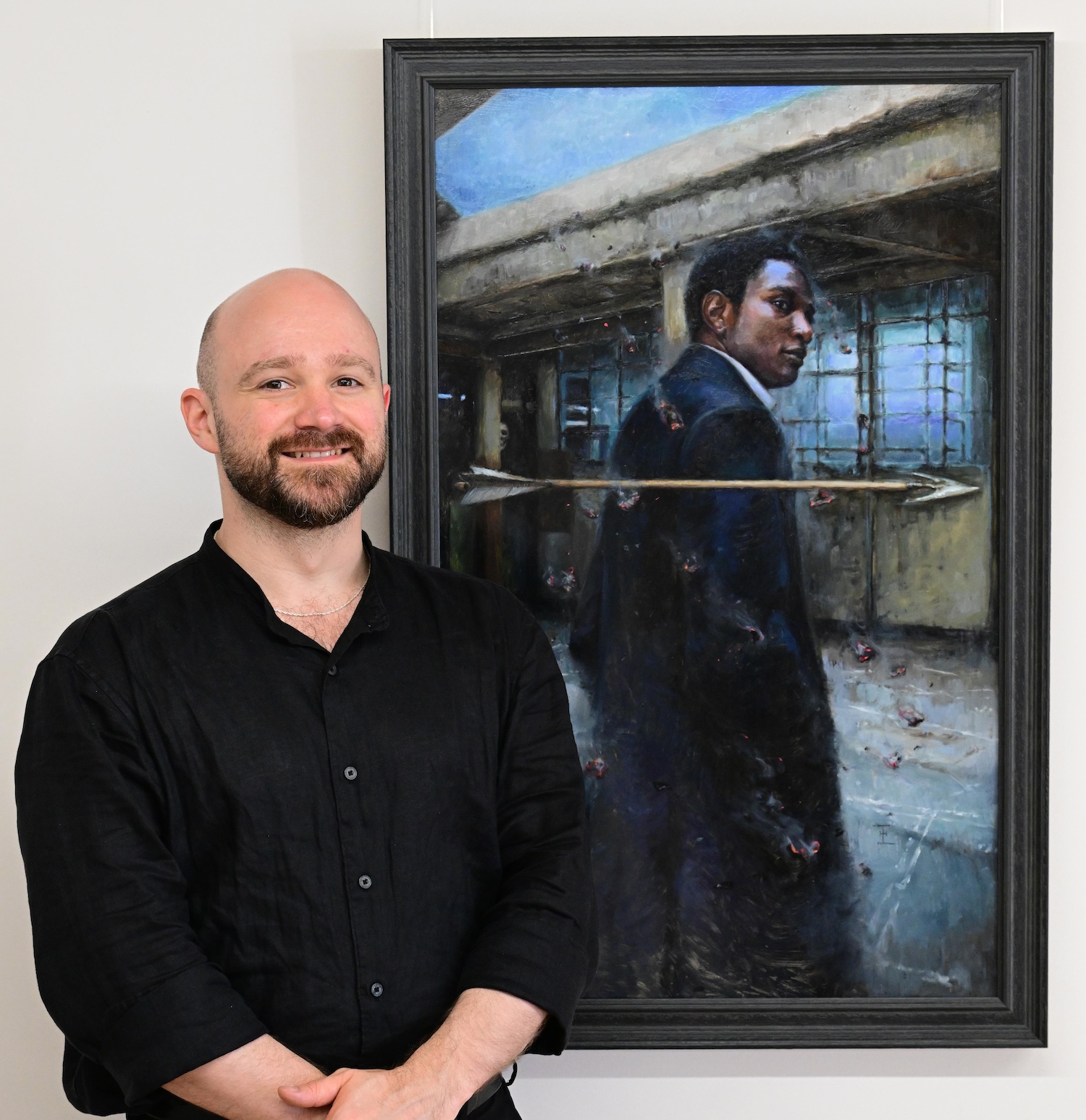
A View of Saturn
Oil on Panel 100cm x 65cm x 5cm www.instagram.com/ianhinleyart
North Yorkshire artist Ian Hinley has been painting in oils for more than twenty years. After leaving a career in illustration to focus fully on his personal practice, he has developed a body of work grounded in technique, the human figure and a deep engagement with history, mythology and symbolic imagery. His breakthrough year in 2024 saw his monumental painting Morpheus Among the Dreams exhibited at Humber Street Gallery, marking a significant moment in his evolving practice.
Ian’s finalist work, A View of Saturn, is a meditation on linear time and the inevitability of change. His approach is shaped by a fascination with how cultural narratives travel across centuries, and how symbols retain or transform their meaning.
“Time is something I think about constantly. I’m always interested in how my work speaks about being now, and also has a dialogue with artwork from the past and human culture from the past in general.”
The painting is set inside a warehouse in Hull, a building whose flaking walls openly display their long history. Ian described the space as a living archive, a site where time is visible on every surface.
“It still bears all the marks and texture of its previous use. It’s an unusual feeling to be in a space going through this journey from its prime to being an aged building. It seemed an appropriate setting for a painting about time.”
Symbols of impermanence appear throughout the work: a skull, chalk marks, ashes and the central motif, time’s arrow. Ian draws on the scientific concept of entropy to articulate the irreversible nature of change.
“The arrow refers to the concept of time’s arrow. Entropy only ever increases. We move from order to disorder. Whether you call that decay is a matter of perspective, but it’s irreversible change.”
Ian reflected on the materiality of painting itself, grounding the work in the physical reality of its making.
“I’m keenly aware that what I’m doing is just putting mud on a surface. It all comes from the earth. To think that this is made from the earth is beautiful, a fight against that condition of going from order to disorder.”
A View of Saturn captures the sensation of recognising time passing through us, altering us, and shaping the spaces we inhabit. It is a work that holds both the weight of history and the immediacy of lived experience, expressed through Ian’s precise and symbolically rich visual language.
Layla Jabbari
Third Place, Emerging Artist Award 2025
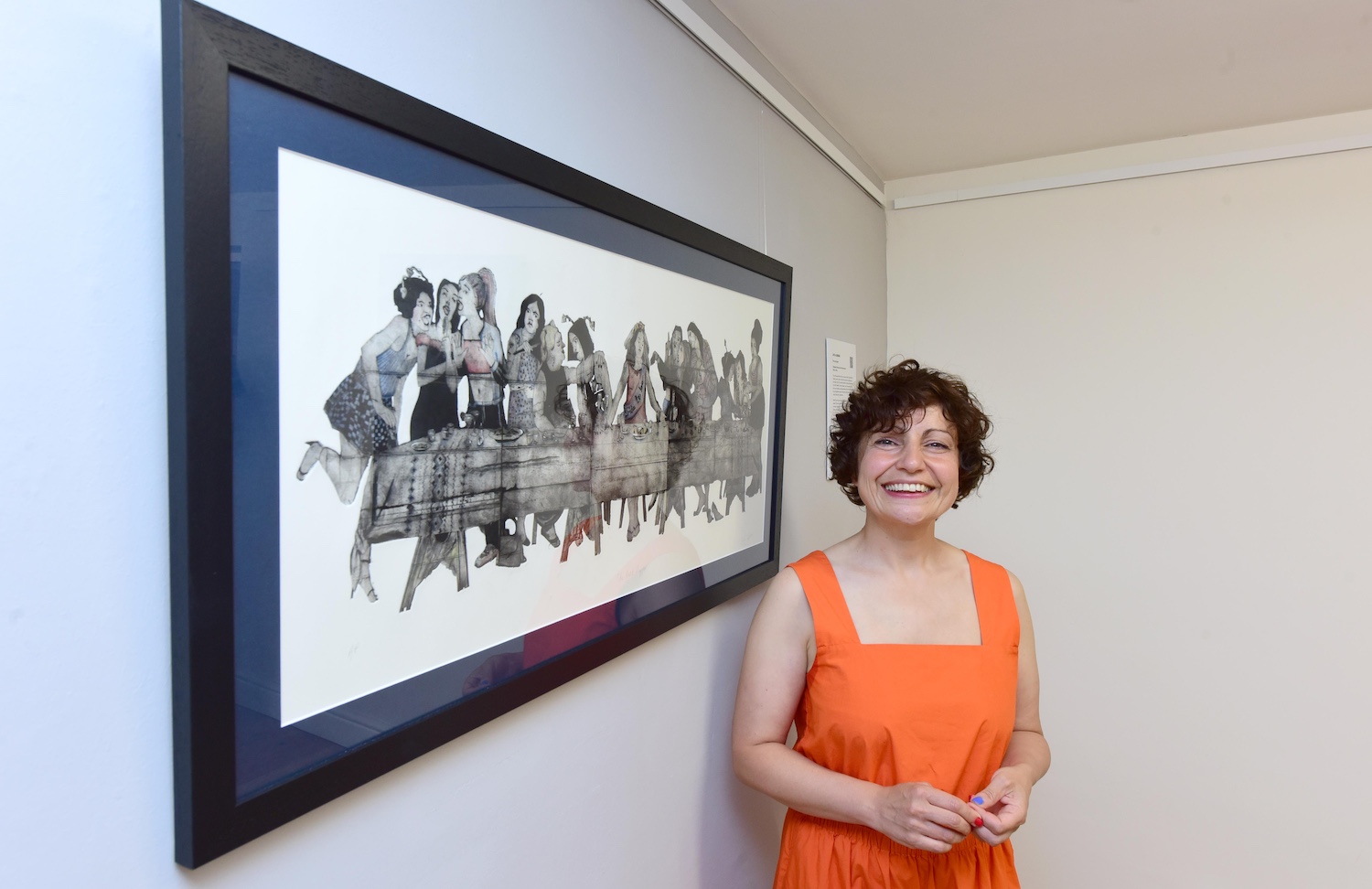
The Last Supper
Collograph Tetrapak print with watercolour 100cm x 50cm www.laylajab.com
Hull based artist Layla Jabbari works primarily in printmaking, using accessible and sustainable materials to tell stories about the people she encounters in everyday life. Her practice is rooted in observation and community, celebrating the narratives, connections and small moments of magic that shape our shared experience. Layla has been recognised widely, including shortlistings for Yorkshire Ones to Watch at Sunnybank Mills and the Flourish Excellence in Printmaking Award with WYPW, Huddersfield. She was also longlisted for the World Illustration Awards.
A central part of Layla’s practice is her commitment to environmentally conscious printmaking. She frequently works with Tetrapak, a recycled and non‑traditional plate material, as an eco‑friendly alternative to single‑use print mediums. Its surface naturally deteriorates with each pass through the press, creating prints that evolve over time and echo the fragility of the stories she captures.
Her finalist work, The Last Supper, reimagines Da Vinci’s iconic composition through the lens of contemporary ritual and women’s stories. Layla’s interest lies in the moments that mark a shift in identity, the threshold between one state of life and another.
“I’m always interested in people and their stories, and the links between people. I wasn’t saying marriage is similar to living and dying, hopefully not, but it is a move from one state to another.”
The work draws on global traditions of pre‑wedding gatherings: Mehndi in India, Polterabend in Germany, Patakhti in Iran, Pyebaek in Korea. Each tradition carries its own history, yet all share the same impulse to gather the most significant people in a woman’s life at a moment of profound transition.
“Throughout the world, women come together before marriage as a safety net. Childbirth was dangerous; you didn’t know what you were going into. These gatherings are about protection, celebration and community.”
The figures in Layla’s composition are drawn from real people she met while sketching in pubs across Hull and Leeds.
“Each figure is someone I came across. People wanted to know what I was doing. It represents that specific time, a Friday night in Hull or Leeds.”
Her Tetrapak plates introduce a material vulnerability that mirrors the conceptual heart of the work. As the carton surface breaks down, each print becomes a unique record of its own transformation, a quiet nod to the rapid deterioration of Da Vinci’s original fresco.
“Unlike a copper plate where you might get fifty identical prints, each Tetrapak print decays. Each one is slightly different; you can see signs of use.” “We don’t really know what it looked like five hundred years ago. Each print becomes a record of its own decay.”
Layla’s version plays with the symbolism of the original, spilled salt, Judas clutching coins, the knife behind the figure, while celebrating women who might be familiar to us: friends, colleagues, loved ones. It is a portrait of community, of shared stories, and of the rituals that bind us.
An Ode to Hull
The talk closed with a generous and energising reflection on Hull’s creative landscape. All three finalists, Lou Hazelwood, Ian Hinley and Layla Jabbari, live and work in the city, and their shared connection to Hull shaped a lively discussion with audience member Jane Young, SCAF’s previous curator. What emerged was a portrait of a place defined by a distinctive artistic character.
The artists spoke about Hull’s long tradition of supporting emerging artists, noting how its cultural identity is sustained by grassroots initiatives, artist‑led spaces and a community that values experimentation. Reinforcing this sentiment by describing Hull as a city where artists feel connected, and where creative energy is carried across studios, collectives and public spaces.
This perspective set out in the talk aligns with the reflections shared in HULL IS THIS announcing the winners last August, which celebrated Hull as a place where artists “forge new paths, challenge expectations and build creative futures rooted in the city’s unique character.” The Emerging Artist Award finalists embody this spirit, each contributing to Hull’s thriving and ever‑expanding creative scene. Their work demonstrates how the city’s environment, people and histories continue to shape artistic practice in meaningful and unexpected ways.
Hull is not simply the backdrop to their work. It is part of the story, part of the process, and part of the momentum that carries these artists forward. This discussion provided such an inspiring tone to the 2025 Emerging Artist Award season, proving that Yorkshire truly is full of creative hot-spots well worth celabrating!
Closing Thoughts - EAA Talk Series 2025
This final talk brought the 2025 Emerging Artist Award series to a close with clarity, generosity and depth. Across all three sessions, the programme revealed the breadth of emerging artistic practice across Yorkshire and the many ways artists are thinking about time, change and the stories that shape us.
The series began with Laura Lee, Archie Brooks and Pennie Metcalfe, whose conversation explored material experimentation, personal narrative and the emotional resonance of making. Their talk opened the programme with an emphasis on process, intuition and the ways artists navigate uncertainty in their work.
The second session centred on Julie Bancroft, whose thoughtful and layered practice invited audiences to consider healing, materiality and the quiet intelligence of natural processes. Her discussion offered a reflective pause within the series, drawing attention to the subtle shifts and accumulations that define both artistic and personal transformation.
This final talk with Lou Hazelwood, Ian Hinley and Layla Jabbari brought the series to its conclusion through a rich exploration of time, memory, ritual and ecology. Their practices, distinct yet deeply connected, demonstrated how artists use symbolism, community, landscape and material instability to understand the world around them. Together, they offered a portrait of artistic practice that is curious, rigorous and profoundly human.
Readers can revisit the full journey of the programme by exploring the first two artist talk posts on the SCAF blog, which sit alongside this final conversation and complete the series.
Across all three talks, the series highlighted the value of conversation and the power of art to hold the complexities of lived experience. It also demonstrated the strength of Yorkshire’s creative ecology, from Hull’s vibrant networks to the wider region’s commitment to supporting new voices. The three winners from 2025's EAA highlight Hull’s role as a dynamic hub within Yorkshire’s wider creative ecology, a place where artists continue to experiment, collaborate and shape new cultural narratives. As we look ahead to the next Emerging Artist Award, which once again celebrates the up and coming careers of artists from across Yorkshire,
this series of talks stand as testament to the creativity flourishing throughout the Yorkshire region that we know will be present once more in our upcoming 2026 award.
If you've enjoyed this series, want to know more about SCAF, and are curious about what we do, then come along to our open day on Sunday the 2nd of August 2026! Free to attend, further details on our homepage!
Stay connected with news and updates!
Join our mailing list to receive the latest news and updates from our team.
Don't worry, your information will not be shared.
We hate SPAM. We will never sell your information, for any reason.